
When news broke that the Society of Saint Pius X (SSPX) had consecrated four bishops despite a personal appeal from Pope Leo XIV not to proceed, many Catholics were left asking the same question: Who exactly is the SSPX, and why does the Vatican consider these consecrations so serious?
The answer reaches back more than half a century and involves some of the most significant theological, liturgical, and canonical debates in modern Catholic history.
While the SSPX considers itself a faithful defender of Catholic Tradition, the Vatican has long maintained that the society’s irregular status and unauthorized actions jeopardize the visible unity of the Church. Understanding the controversy requires looking beyond the headlines and examining both the society’s origins and the Church’s response.
The Birth of the SSPX
The Society of Saint Pius X was founded in 1970 by French Archbishop Marcel Lefebvre, a respected missionary bishop and former Superior General of the Holy Ghost Fathers.
Its name honors Pope St. Pius X, remembered for his defense of Catholic doctrine and promotion of frequent Holy Communion.
The society was established during a period of tremendous change following the Second Vatican Council (1962–1965), which introduced reforms intended to renew the Church and strengthen its engagement with the modern world.
Among the council’s changes were expanded use of local languages in the liturgy, greater emphasis on dialogue with other Christians and non-Christian religions, renewed teaching on religious liberty, and reforms to priestly formation and pastoral life.
Archbishop Lefebvre believed many of these reforms—and especially the way they were implemented in dioceses around the world—represented a dangerous departure from the Church’s tradition. He founded the SSPX to preserve traditional Catholic doctrine, priestly formation, and the celebration of the Mass according to the 1962 Roman Missal, commonly known today as the Traditional Latin Mass.
Today, the SSPX operates seminaries, schools, chapels, and retreat centers around the world and serves Catholics in dozens of countries.
What Does the SSPX Believe?
Contrary to some misconceptions, the SSPX does not reject Catholic doctrine.
Its priests celebrate the seven sacraments, profess the Nicene Creed, honor the Blessed Virgin Mary and the saints, recognize the Pope as the successor of St. Peter, and affirm the authority of Sacred Scripture and Sacred Tradition.
The primary disagreements concern certain teachings and reforms associated with the Second Vatican Council.
The SSPX argues that documents concerning religious liberty, ecumenism, collegiality, and relations with non-Christian religions contain ambiguities that have contributed to confusion within the Church.
The Holy See, however, teaches that Vatican II was a legitimate ecumenical council whose teachings must be interpreted in continuity with the Church’s longstanding tradition rather than as a break from it.
Successive popes have acknowledged that some post-conciliar abuses occurred but have consistently defended the council itself as an authentic exercise of the Church’s teaching authority.
Why the Latin Mass Matters
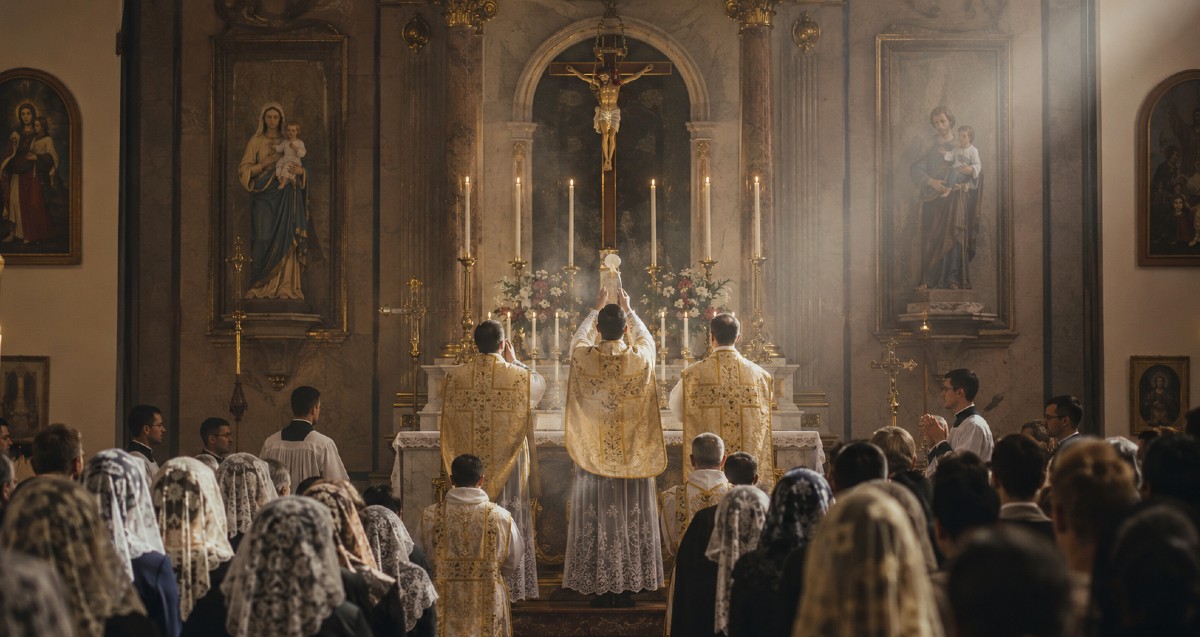
One of the society’s most visible characteristics is its commitment to the Traditional Latin Mass.
This form of the Roman Rite was the ordinary form of Mass for centuries before the liturgical reforms following Vatican II.
Many Catholics are drawn to the Traditional Latin Mass because of its silence, sacred music, ritual symbolism, use of Latin, and continuity with centuries of Catholic worship.
While many faithful who attend the Latin Mass remain fully integrated within diocesan life, the SSPX believes preserving this liturgy is inseparable from preserving what it sees as the fullness of Catholic tradition.
The Vatican, however, has repeatedly emphasized that attachment to the older liturgy must not become a rejection of the Church’s legitimate authority or of the liturgical reforms approved by the Church.
The 1988 Turning Point
The defining moment in the SSPX’s relationship with Rome came in 1988.
Archbishop Lefebvre believed the society’s future depended upon having bishops who could ordain priests and administer confirmations according to the traditional rites.
After years of negotiations with the Holy See, he concluded that Rome would not provide bishops quickly enough.
Despite repeated warnings from Pope St. John Paul II, Lefebvre consecrated four bishops without papal approval.
The Vatican declared that both Lefebvre and the newly consecrated bishops had incurred automatic excommunication under canon law because the consecrations were performed without the required pontifical mandate.
Pope John Paul II described the act as a schismatic one because it represented a refusal of submission to the Roman Pontiff in a matter touching the Church’s governance.
The SSPX rejected that assessment, arguing that an extraordinary crisis in the Church justified extraordinary action under the principle of necessity.
This disagreement has remained at the center of the controversy ever since.
What Happened After 1988?
Relations gradually improved in some respects.
In 2009, Pope Benedict XVI lifted the excommunications of the four surviving bishops consecrated in 1988 as a gesture intended to foster reconciliation.
However, lifting those excommunications did not resolve the society’s canonical status.
The SSPX continued to exist outside the Church’s normal juridical structures.
Its priests remained validly ordained, but they generally exercised ministry without the ordinary canonical faculties enjoyed by diocesan priests.
Pope Benedict repeatedly expressed hope for full reconciliation but insisted that doctrinal questions still required resolution.
Pope Francis and New Faculties
During the Extraordinary Jubilee of Mercy in 2015, Pope Francis surprised many observers by granting SSPX priests the faculty to validly and licitly hear sacramental confessions.
When the Jubilee ended, he extended that permission indefinitely.
He also authorized local bishops to delegate SSPX priests to witness marriages under certain circumstances to provide greater certainty for the faithful.
These decisions did not regularize the SSPX’s canonical status, but they demonstrated the Holy Father’s pastoral concern for Catholics who worship at SSPX chapels and his desire to continue dialogue.
Why Are Unauthorized Consecrations So Serious?
The recent consecrations have revived one of the Church’s deepest concerns.
In Catholic teaching, bishops are successors of the Apostles.
Their ministry is not simply local leadership but participation in the universal episcopate united with the Pope.
For this reason, the Church requires a pontifical mandate before a bishop may consecrate another bishop.
The rule is not viewed as a bureaucratic formality but as an essential safeguard of ecclesial unity.
Without it, competing groups could establish parallel hierarchies independent of the Church’s visible governance.
The Vatican therefore argues that unauthorized episcopal consecrations strike directly at the unity Christ entrusted to the Apostles and their successors.
The SSPX maintains that the Church faces an unprecedented doctrinal crisis requiring extraordinary measures to preserve traditional Catholic life.
The Holy See has consistently rejected that justification, insisting that no perceived emergency authorizes setting aside the Pope’s role in governing the Church.
Is the SSPX in Schism?
This is perhaps the most misunderstood aspect of the controversy.
The Holy See has often described the society’s situation as “canonically irregular.”
While Vatican officials have referred to the 1988 consecrations as a schismatic act, the Church has generally stopped short of declaring the SSPX itself to be formally in schism.
Instead, Rome has continued decades of dialogue aimed at reconciliation while acknowledging that the society remains outside full canonical regularity.
As a result, the SSPX occupies a unique position.
Its priests are validly ordained.
Many of its sacraments are valid.
Its members identify as Catholic.
Yet the society does not enjoy the full juridical recognition or ordinary faculties that characterize institutes fully integrated into the Church’s canonical life.
Why Some Catholics Support the SSPX
Many faithful who attend SSPX chapels are motivated less by controversy than by a love for traditional worship.
They appreciate reverent liturgy, traditional preaching, classical Catholic education, and continuity with centuries of Catholic practice.
Some also express concern about declining Mass attendance, weakened catechesis, and doctrinal confusion in parts of the Church since the 1960s.
The SSPX presents itself as preserving what it believes has always been taught and practiced.
Why the Vatican Continues to Object
The Holy See’s concern is not primarily about Latin, older liturgical books, or traditional devotions.
The Church permits the Traditional Latin Mass in various circumstances and has long recognized the value of the Church’s liturgical heritage.
Rather, the central issue is authority.
Catholic ecclesiology teaches that bishops exercise their ministry in communion with one another and with the successor of St. Peter.
When bishops are consecrated without papal approval, the Vatican believes the visible bonds of ecclesial unity are seriously wounded.
That concern explains why successive popes—from St. John Paul II and Benedict XVI to Francis and now Pope Leo XIV—have all sought reconciliation while insisting that unity with the Roman Pontiff cannot be separated from fidelity to Catholic Tradition.
Looking Ahead
The latest episcopal consecrations have once again highlighted one of the Catholic Church’s longest-running internal disputes.
Whether the relationship between Rome and the SSPX ultimately moves toward reconciliation or greater separation will depend on questions that go beyond liturgy. They touch the very nature of authority, tradition, and unity within the Catholic Church.
For faithful Catholics trying to understand the controversy, it is important to recognize that this is not simply a disagreement over the Latin Mass. Rather, it is an ongoing debate about how the Church faithfully preserves Sacred Tradition while remaining visibly united under the successor of St. Peter—a balance the Catholic Church has sought to maintain throughout her history.
Your support brings the truth to the world.
Catholic Online News exists because of donors like you. We are 100% funded by people who believe the world deserves real, uncensored news rooted in faith and truth — not corporate agendas. Your gift ensures millions can continue to access the news they can trust — stories that defend life, faith, family, and freedom.
When truth is silenced, your support speaks louder.

I love the new video shorts in the article! Thank you for doing this, I can listen real quick on a news article when I am running short of time:) Really appreciate you doing this for us Catholics who never seem to have the time to read an article! I first saw this while I was scrolling on YouTube! Thanks again.