

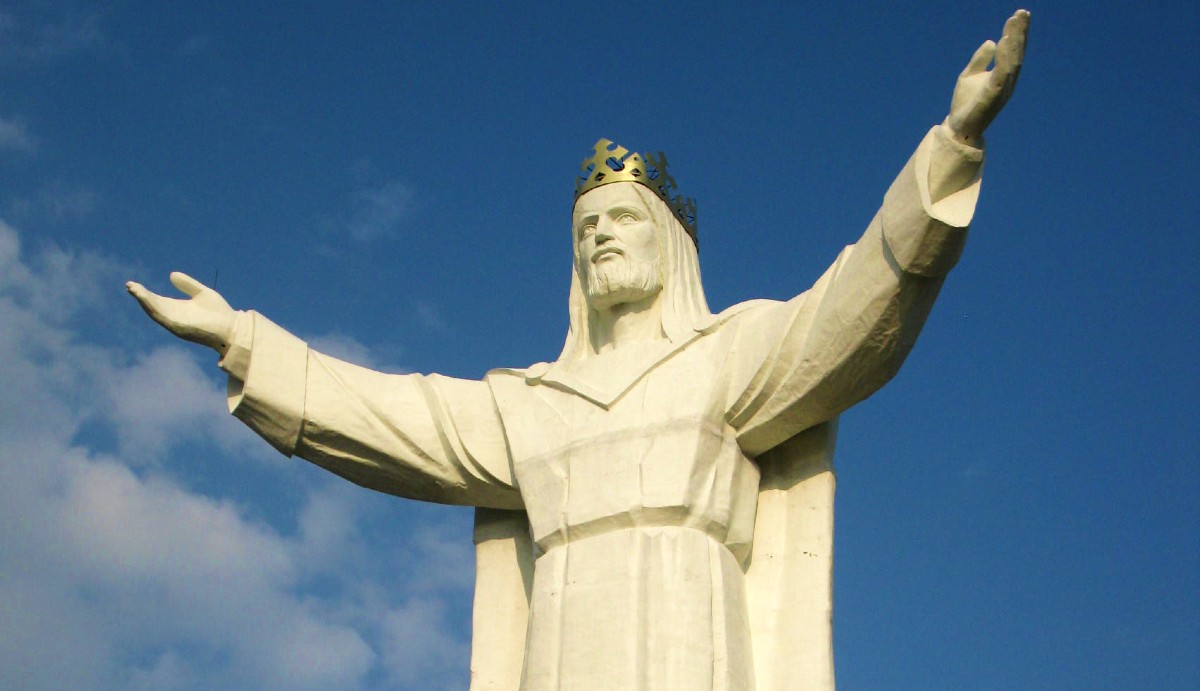
For centuries, Christians have proclaimed the words “Christ is King” as a declaration of faith in Jesus Christ as the divine ruler of all creation. The phrase reflects a central belief shared by Catholics and many Protestants, and the Church even celebrates the Solemnity of Christ the King each year to honor Christ’s universal authority.
However, in recent years the phrase has increasingly appeared in political contexts, sparking debate about how sacred religious language is being used in public discourse.
According to the Associated Press, the proclamation “Christ is king” has appeared at political rallies, on social media, and in speeches by some voices on the political right. While many Christians continue to use the phrase purely as a statement of faith, others say it has sometimes been used in ways that politicize or distort its religious meaning.
At times, activists have linked the phrase to arguments that the United States should be understood as a Christian nation or that the country should specifically acknowledge allegiance to the Christian God. Some current Cabinet officials and recent members of Congress have used the phrase publicly in speeches or online posts, according to the Associated Press.
Our Important Lenten Message – Please Watch
More controversially, critics say the phrase has occasionally been paired with anti-Zionist rhetoric or negative stereotypes about Jewish people.
A 2025 report from the Rutgers University–affiliated Network Contagion Research Institute examined how the phrase has appeared online in recent years. The report said there had been a significant rise in social media posts using “Christ is king,” with some examples functioning as what researchers described as a hate meme directed at Jews.
“The weaponization or hijacking of ‘Christ is King’ represents a disturbing inversion of its original intent,” the report said, according to the Associated Press. “Rather than sacralizing shared values, extremists have exploited this religious expression to justify hatred.”
The issue recently surfaced during a hearing of the Religious Liberty Commission, a body created by President Donald Trump. During the February 9 hearing, Seth Dillon, CEO of the satirical website The Babylon Bee, described hearing the phrase used alongside slurs targeting Jews.
“This should offend every Christian,” Dillon said, according to the Associated Press.
Dillon emphasized that the phrase itself is not antisemitic and is commonly used by Christians as a profession of faith. “Christ is my king,” he said, but added that context matters.
He testified that some extremist groups have attempted to co-opt the phrase, including followers of far-right commentator Nick Fuentes. Dillon described this use as “using the Lord’s name in an abusive manner,” according to the Associated Press.
Researchers cited by the Associated Press have also pointed to similar concerns. The Network Contagion Research Institute reported that Fuentes and some of his followers have used the phrase as part of antisemitic messaging online. The group described the slogan being deployed as a “white supremacist mantra publicizing their antisemitic beliefs.”
Yet not all uses of the phrase in public life have been controversial. Some Catholic and evangelical figures on the political right who strongly support Israel have also used the phrase in speeches while simultaneously denouncing antisemitism.
Brian Kaylor, president and editor-in-chief of the religion and politics publication Word&Way, told the Associated Press that the phrase itself is religious, but its growing presence in political rhetoric has created confusion.
“The religious phrase ‘Christ is king’ is not inherently political,” Kaylor said. However, he warned that its use in ideological contexts can give speakers “deniability” when critics question their intentions.
The broader debate also reflects ongoing divisions within politics and religion, particularly surrounding attitudes toward Israel and Zionism.
The Catholic Church itself maintains diplomatic relations with Israel while also recognizing the state of Palestine and advocating for a peaceful two-state solution. According to the Associated Press, Pope Leo XIV has called for such a solution while also condemning antisemitism. During the Israel-Hamas war, both Pope Francis and Pope Leo condemned the Oct. 7, 2023 attacks by Hamas while also criticizing Israel’s military response and calling for an end to the suffering of civilians.
Catholic teaching has long rejected antisemitism. The Second Vatican Council’s landmark 1965 document Nostra Aetate explicitly rejected the idea that Jewish people collectively bear responsibility for the death of Christ and called on Catholics to reject hatred and persecution directed toward Jews.
As the public debate continues, many Christians emphasize that the phrase “Christ is King” should remain what it has always been meant to be: a proclamation of the sovereignty of Jesus Christ over all humanity, expressed in humility and charity rather than used as a political weapon.
Your support brings the truth to the world.
Catholic Online News exists because of donors like you. We are 100% funded by people who believe the world deserves real, uncensored news rooted in faith and truth — not corporate agendas. Your gift ensures millions can continue to access the news they can trust — stories that defend life, faith, family, and freedom.
When truth is silenced, your support speaks louder.


