

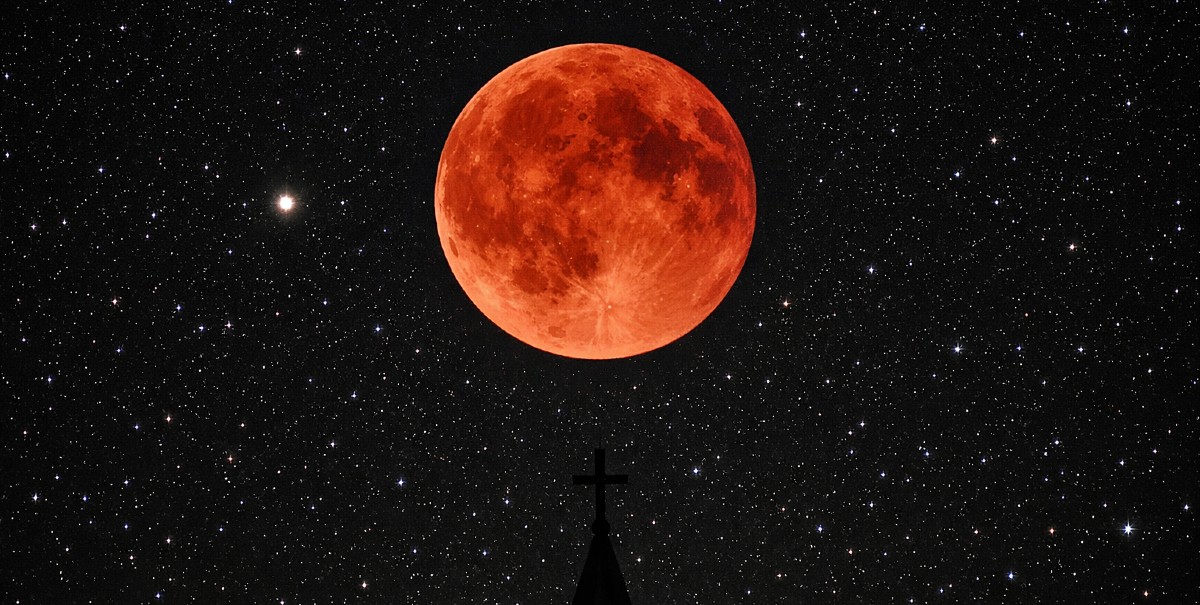
A rare total lunar eclipse will soon cast the moon in a deep red glow, offering Catholics a powerful reminder of the beauty and order of God’s creation. Skywatchers across North America, Australia, and New Zealand will witness what is commonly known as a “blood moon,” an event that will not occur again for nearly three years.
During a total lunar eclipse, the Earth moves directly between the sun and the moon, blocking the sun’s direct light and casting a shadow over the lunar surface. Yet the moon does not disappear. Instead, it often turns a striking shade of red.
Astrophysicist Dr. Rebecca Allen of Swinburne University explained that as the full moon passes into Earth’s shadow, it changes color to a “deep and coppery red,” according to The Guardian. She noted that “any light that does pass shines through our atmosphere and transforms the lunar surface into a deep, coppery red,” according to the same report.
Dr. Brad Tucker, an astrophysicist at Australian National University, described the phenomenon as a small amount of sunlight that “skims” the Earth’s atmosphere, according to The Guardian. “Just as a sunset or sunrise can be pink or red, this light is also refracted and so lights up the moon in an orange-red colour,” he said, according to the publication.
Our Important Lenten Message – Please Watch
For Catholics, such moments in the sky naturally call to mind Psalm 19: “The heavens declare the glory of God.” While modern astronomy explains the mechanics of the eclipse, the event still inspires awe and gratitude for the Creator who set the planets in motion.
Viewing Times Around the World
In Australia, the eclipse will be visible Tuesday night, with major cities such as Sydney, Canberra, Melbourne, and Hobart seeing it begin at 10:04 p.m. and end at 11:02 p.m., according to The Guardian. Brisbane, Adelaide, Darwin, and Perth will each have slightly different start times earlier in the evening.
In New Zealand, the eclipse will reach its “deepest point” shortly after midnight, when the moon is high in the sky. Professor Richard Easther of the University of Auckland said, “It will be visible everywhere in the country. Everyone who can see the moon will see the eclipse,” according to The Guardian. He added, “As an astronomer, I am excited by anything that encourages people to ‘look up’ and experience the night sky for themselves,” according to the report.
In North America, observers in cities such as New York and Washington, D.C., will see the eclipse begin around 3:44 a.m., while those on the West Coast, including San Francisco and Los Angeles, will see it begin shortly after 12:44 a.m., according to The Guardian, citing information from NASA and Time and Date.
Astronomers advise finding a dark location away from city lights and allowing time for your eyes to adjust. Jupiter will also be visible high in the sky, creating what Allen called “a great pairing,” according to The Guardian.
Looking Ahead
Total lunar eclipses occur approximately every 18 months to three years. According to Allen, as cited by The Guardian, the next total eclipse will take place on New Year’s Eve in 2028 and will be visible in Europe, Asia, Australia, and Africa, but not in the Americas. The next total lunar eclipse visible in North America will be in June 2029.
A partial eclipse is also scheduled for 28 August 2026, with the best views expected in the Americas and Africa, according to The Guardian.
Meaning Then and Now
Today, scientists emphasize that a blood moon is a natural and predictable astronomical event. Allen described such eclipses as “a breathtaking reminder that we are living on a moving planet, in a dynamic solar system. Just one small, wonderful world, drifting through space,” according to The Guardian.
Historically, however, many cultures interpreted lunar eclipses as ominous signs. According to The Guardian, astronomy lecturer Daniel Brown wrote that the ancient Inca saw the red moon as a jaguar attacking and eating it, while in ancient Mesopotamia it was considered a direct assault on the king. The Luiseño tribes of California sang healing songs to what they believed was a wounded moon, and more recently, some Christian circles popularized apocalyptic interpretations in connection with so-called “blood moon prophecy.”
For Catholics, the Church does not attach prophetic meaning to such events. Instead, moments like these invite contemplation, humility, and wonder. As the March full moon—also known as the “worm moon,” a name tied to the warming soil and early signs of spring in the northern hemisphere, according to the Old Farmer’s Almanac cited by The Guardian—glows red in the night sky, the faithful are invited to pause, look up, and remember that creation itself points beyond itself to its Creator.
Your support brings the truth to the world.
Catholic Online News exists because of donors like you. We are 100% funded by people who believe the world deserves real, uncensored news rooted in faith and truth — not corporate agendas. Your gift ensures millions can continue to access the news they can trust — stories that defend life, faith, family, and freedom.
When truth is silenced, your support speaks louder.