

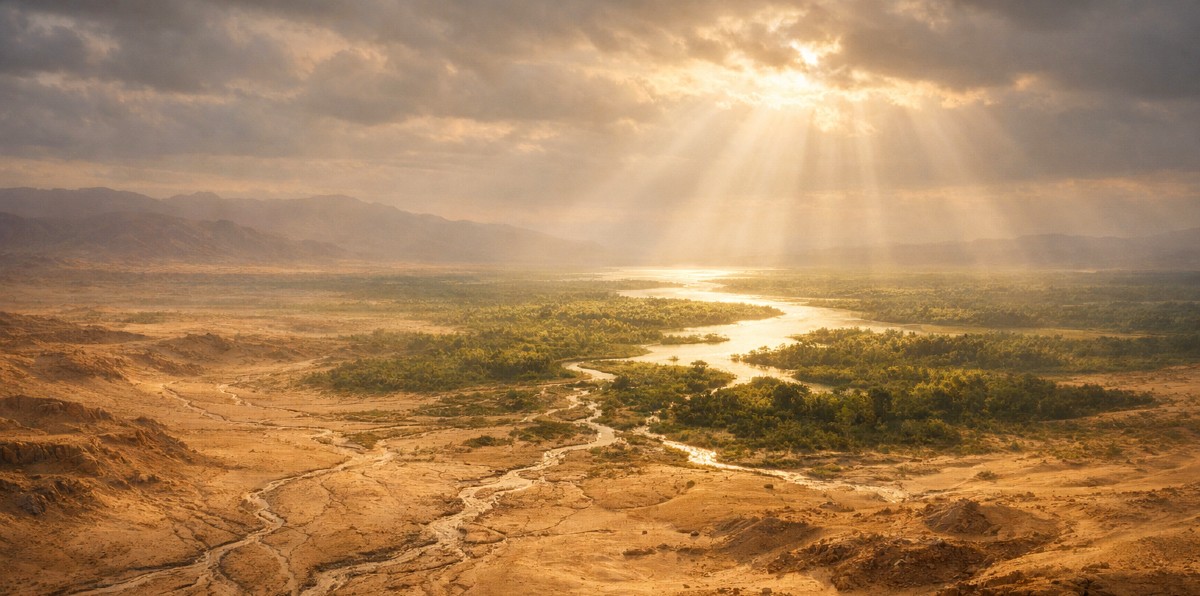
Recent satellite imagery identifying long-dry river systems in the Middle East has reignited scholarly and theological discussion about the geographical backdrop of the Book of Genesis, prompting renewed reflection on how Scripture may preserve memories of real ancient landscapes.
According to Daily Mail, scientists analyzing orbital radar scans have identified an ancient riverbed in Saudi Arabia known as Wadi al-Batin, which some researchers believe corresponds to the biblical river Pishon described in Book of Genesis. Genesis speaks of a single river flowing out of Eden and dividing into four branches: the Pishon, Gihon, Tigris, and Euphrates.
While the Tigris and Euphrates remain well-known rivers today, the Pishon and Gihon have long been the subject of speculation. The newly highlighted satellite data shows that Wadi al-Batin once stretched from western Arabia toward the Persian Gulf, forming a wide and fertile waterway during a wetter climatic period thousands of years ago.
A Lenten Message from Sister Catherine – Please Watch
“These satellite images give us a window into landscapes that have vanished over millennia,” said Dr. Farouk El-Baz, a geologist who first analyzed the radar imagery in the early 1990s. “We can now trace rivers that once shaped human settlement and perhaps even inspired ancient biblical narratives,” according to the report.
Additional attention has been drawn to Iran’s Karun River, which some scholars associate with the biblical Gihon. The river’s winding path through the Zagros Mountains aligns with the Hebrew term used in Genesis, which conveys the idea of encircling or twisting around a land.
Biblical archaeologist James A. Sauer cautioned against drawing definitive conclusions, noting that while Wadi al-Batin’s features “best match the biblical description of the Pishon,” the evidence does not amount to proof of the Garden of Eden itself, according to the article. Archaeologist Juris Zarins similarly suggested that the Genesis account may reflect authentic ancient geography, even if its deeper meaning remains theological rather than cartographic.
Not all interpretations point to the same region. Some scholars continue to identify the land of Cush mentioned in Genesis with Africa, leading to alternative theories that associate the Gihon with the Nile. The article also references a more recent proposal placing Eden near Lake Tana in Ethiopia, though that theory has not been peer-reviewed.
For Catholics, these discussions touch on a familiar tension between historical inquiry and revealed truth. The Church has long taught that Scripture communicates divine realities through human language, often employing symbolic and theological imagery grounded in the lived experience of ancient peoples.
Whether or not these rivers can be definitively mapped, the renewed interest underscores a central Catholic understanding: Genesis speaks not merely to geography, but to humanity’s origin, vocation, and fall, using the real world known to its earliest hearers to reveal eternal truths.
As scientific tools continue to uncover traces of vanished landscapes, they offer new opportunities to appreciate how the inspired authors of Scripture may have woven observable history into the sacred story of salvation—inviting believers not simply to locate Eden on a map, but to seek restoration through Christ, the new Adam.
Your support brings the truth to the world.
Catholic Online News exists because of donors like you. We are 100% funded by people who believe the world deserves real, uncensored news rooted in faith and truth — not corporate agendas. Your gift ensures millions can continue to access the news they can trust — stories that defend life, faith, family, and freedom.
When truth is silenced, your support speaks louder.