
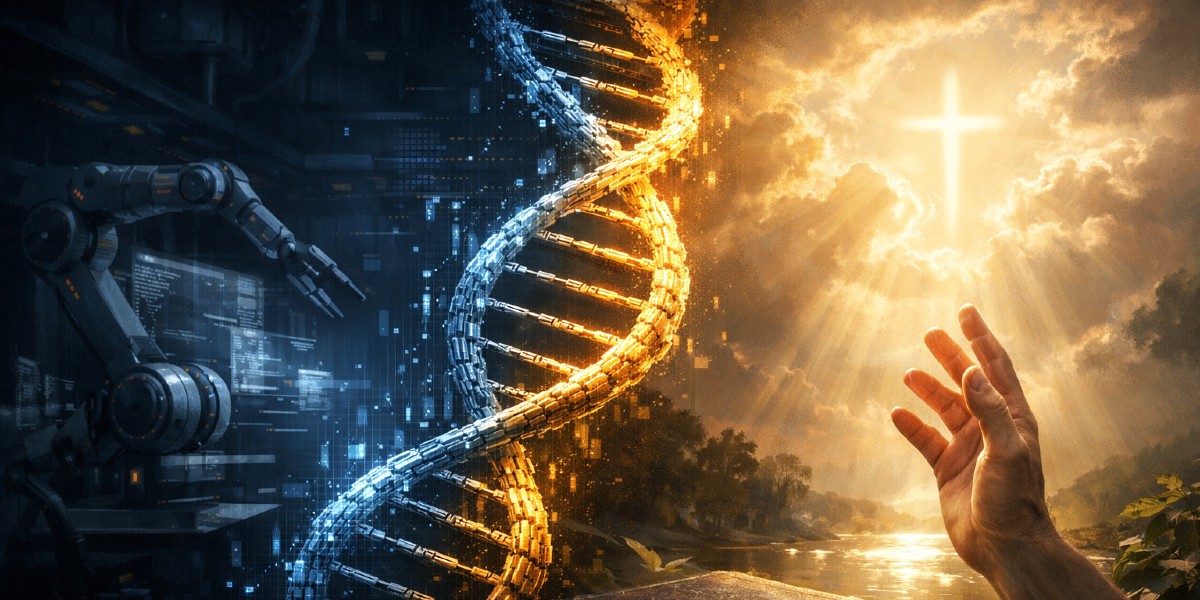
A recent report in the Daily Mail describes what its writers call a “major leap forward” in science: the creation of a brand-new virus designed by artificial intelligence and built entirely in a laboratory. While the scientific achievement is being celebrated in some circles, Catholics should pause and ask deeper moral and theological questions about what this kind of research means for humanity, creation, and our relationship with God.
According to the Daily Mail, scientists used an AI system called Evo2 to design a virus “that has never been seen before,” one containing just 11 genes and engineered specifically to kill dangerous E. coli bacteria. The virus, named Evo–Φ2147, was reportedly created from scratch and shown to kill bacteria faster than naturally occurring viruses.
Dr. Adrian Woolfson, a leader of the research, told the Daily Mail: “Natural evolution now has a co-author. That co-author, the emerging ability of AI-driven genome design and genome construction technologies, has the potential to exist alongside natural evolution.” For Catholics, this statement alone raises serious concerns. Creation, ordered by God and sustained by His providence, is not a collaborative project between nature and machines. Scripture teaches that life is not authored by human ingenuity but received as a gift.
An Urgent Message from Sister Sara – Please Watch
The article explains that Evo2 was trained on “nine trillion ‘base pairs’” of genetic data, allowing it to generate entirely new DNA sequences. These sequences were then assembled using a technology called Sidewinder, which makes genome construction “1,000 times cheaper and 1,000 times quicker,” according to the report. The ability to rapidly manufacture genetic material may sound efficient, but efficiency alone is not a moral good.
Catholic teaching consistently warns against technological power divorced from ethical restraint. While the scientists claim noble goals—such as combating antibiotic resistance—the same article acknowledges the dangers. The Daily Mail notes that “previous research has raised concerns that AI–designed pathogens could themselves become a deadly threat to humanity.” It further reports that experts on existential risk consider “an AI–designed plague to be one of the five biggest risks the world faces.”
These concerns are not hypothetical. The article references earlier studies in which AI systems were used to design proteins that could mimic deadly toxins, some of which could bypass existing safety filters. Even the researchers involved admit the risks. As quoted in the Daily Mail, Dr. King and Dr. Hie wrote: “Evo cannot generate human viral sequences due to deliberate training data exclusions, preventing both accidental and intentional misuse for pathogen design.” That reassurance, however, depends entirely on human oversight remaining perfect—an assumption history does not support.
From a Catholic perspective, the issue is not simply whether a tool can be used for good, but whether certain lines should be crossed at all. Human beings are stewards of creation, not its engineers in the ultimate sense. The Catechism warns against forms of domination that reduce life to an object of manipulation rather than reverence.
The promise of faster vaccines or personalized cancer treatments does not erase the moral danger of normalizing the creation of artificial life. Once life becomes something designed, optimized, and rewritten at will, its inherent dignity is at risk of being replaced by utility and control.
The Daily Mail article frames this breakthrough as progress. Catholics must ask a different question: progress toward what? Scientific advancement that ignores moral truth does not lead humanity closer to God, but farther from Him. As history has shown, when human beings attempt to take the place of the Creator, the result is not salvation, but suffering.
In an age increasingly fascinated by artificial intelligence, Catholics are called to witness to a higher wisdom—one that recognizes life as sacred, creation as ordered by God, and limits as not obstacles, but protections.
Your support brings the truth to the world.
Catholic Online News exists because of donors like you. We are 100% funded by people who believe the world deserves real, uncensored news rooted in faith and truth — not corporate agendas. Your gift ensures millions can continue to access the news they can trust — stories that defend life, faith, family, and freedom.
When truth is silenced, your support speaks louder.