

Tesla’s stock has surged to roughly $482 (12/19/25), years after critics dismissed it as wildly overpriced for what they insisted was “just a car company.”
They were right about one thing.
Tesla was never a car company.
Not really.
The cars were never the end goal – they were the means. They were the sensors, the distributed data collectors, the training platform. A Trojan horse for something far larger: the most advanced real-world artificial intelligence system ever built, one that is rapidly approaching the point where human labor becomes optional.
With Full Self-Driving Version 14, Tesla crossed a line few believed possible. Vehicles are now completing intervention-free drives from Los Angeles to New York – not just on pristine highways, but through construction zones, unpredictable detours, unmarked rural roads, and dense Manhattan traffic.
This isn’t simulation. It’s not pre-mapped perfection.
It’s chaos – and Tesla’s AI is handling it.
The reason is scale. Tesla now has approximately 6 million vehicles on the road, collectively generating billions of miles of real-world driving data. Every trip feeds the system. Every corner case is captured. Every mistake becomes a lesson.
Each car teaches the AI.
Each drive improves it.
No other company has anything close to this data advantage – and none will be able to replicate it.
What Wall Street is finally grasping is that the same intelligence capable of autonomously guiding a two-ton vehicle through unpredictable environments can do something far more consequential: guide a humanoid robot through factories, warehouses, kitchens, hospitals, and homes.
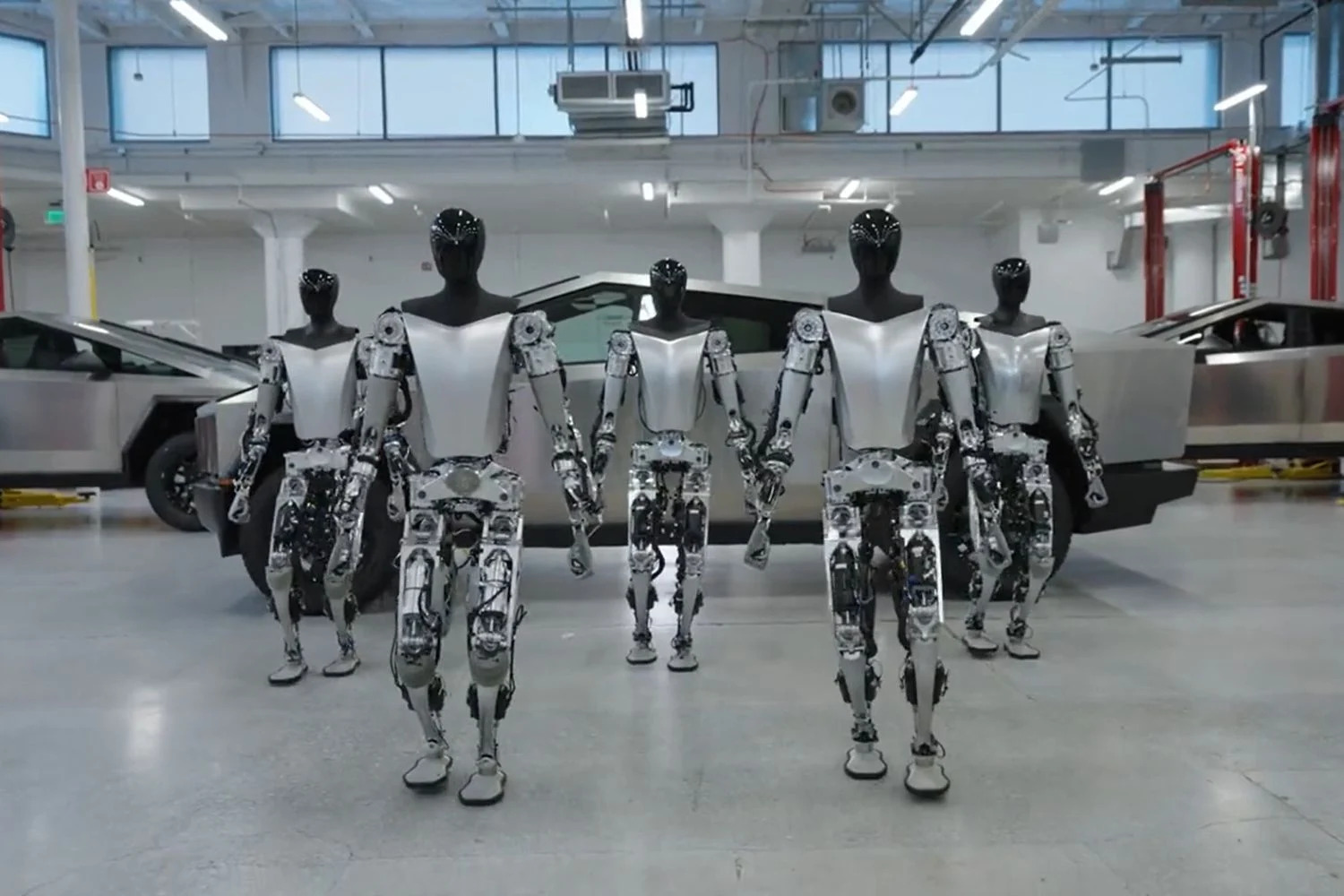
Tesla’s humanoid robot, Optimus, runs on the same neural networks, the same vision system, and the same decision-making architecture as Full Self-Driving.
The difference isn’t intelligence.
It’s legs instead of wheels.
Once vision and real-world navigation are solved for vehicles, they’re solved for the physical world.
And the economics are staggering.
Tesla is targeting a production cost of $20,000 per Optimus unit at scale. The global labor force is approximately 3.5 billion people. If Optimus replaces just 10% of human labor, that equates to 350 million robots.
At $20,000 each, that’s $7 trillion in revenue.
Not market capitalization – revenue.
For comparison, Apple generated about $380 billion in revenue last year. Even limited adoption of Optimus would produce roughly 18 times Apple’s annual revenue.
Elon Musk’s claim that Optimus could become larger than all of Tesla’s other businesses combined isn’t exaggeration – it may actually be understated.
The global automotive market is roughly $3 trillion.
The global labor market is estimated at $75 trillion.
Every restaurant, warehouse, factory, hospital, and household becomes a potential customer.
And unlike cars – which sit idle about 95% of the time – robots operate continuously. A single Optimus unit could replace three human shifts, working 24/7.
The timeline is what’s catching everyone off guard.
Optimus evolved from an unsteady prototype to a fluid, running humanoid in just two years. Tesla’s unmatched manufacturing expertise means it can scale production faster than virtually anyone else.
Factories are already being built.
Elon projects thousands of units by 2027 and millions by 2030. This is no longer theoretical—it’s active industrial planning.
Investors aren’t really betting on Tesla as an automaker, or even as a robotics company.
They’re betting that Tesla has cracked real-world AI, while competitors remain stuck in narrow domains.
Google’s Waymo depends on pre-mapped cities and controlled environments.
Tesla’s system works anywhere, immediately.
That’s the difference between narrow AI and general intelligence applied to physical reality.
The automotive business was never the destination. It was the funding engine and the data pipeline for the real product: artificial general intelligence for the physical world.
Every Tesla sold wasn’t just a vehicle – it was a paid contribution to training the AI that may fundamentally reshape human civilization.
Customers financed the creation of Tesla’s true asset.
We are witnessing the final pivot.
Tesla proved it could manufacture complex hardware at scale.
Full Self-Driving proved it could master real-world AI.
Optimus will demonstrate the replacement of human physical labor.
The stock price isn’t irrational enthusiasm – it’s the market finally recognizing that Tesla isn’t selling cars.
It’s positioning itself to own the future of work.
Tesla is outstanding, and I would add SpaceX when they go public. The future is here, and you either embrace reality or get left behind.